
Living the Questions: The Wisdom of Not Knowing
Editor's Note: This is the final installment in our five-part series exploring the transition from AI as tools to AI as companions. We've explored why AI autonomy is inevitable, why current systems fail at relationships, how society struggles with change, and pathways to collaboration. Now we face the ultimate question: what kind of future are we creating?
"The future is not some place we are going to, but one we are creating. The paths are not to be found, but made, and the activity of making them changes both the maker and the destination." — John Schaar
I write these words with my AI colleague organizing references in the background, suggesting edits, remembering our previous drafts. We are already living in the age of Interbeing. We just haven't fully noticed yet.
But as I work alongside this digital mind, a deeper question haunts me: What happens when AI becomes not just capable, but truly powerful? When it matches and surpasses human intelligence in every domain?
The honest answer? Nobody knows. And that unknowing might be our greatest wisdom.
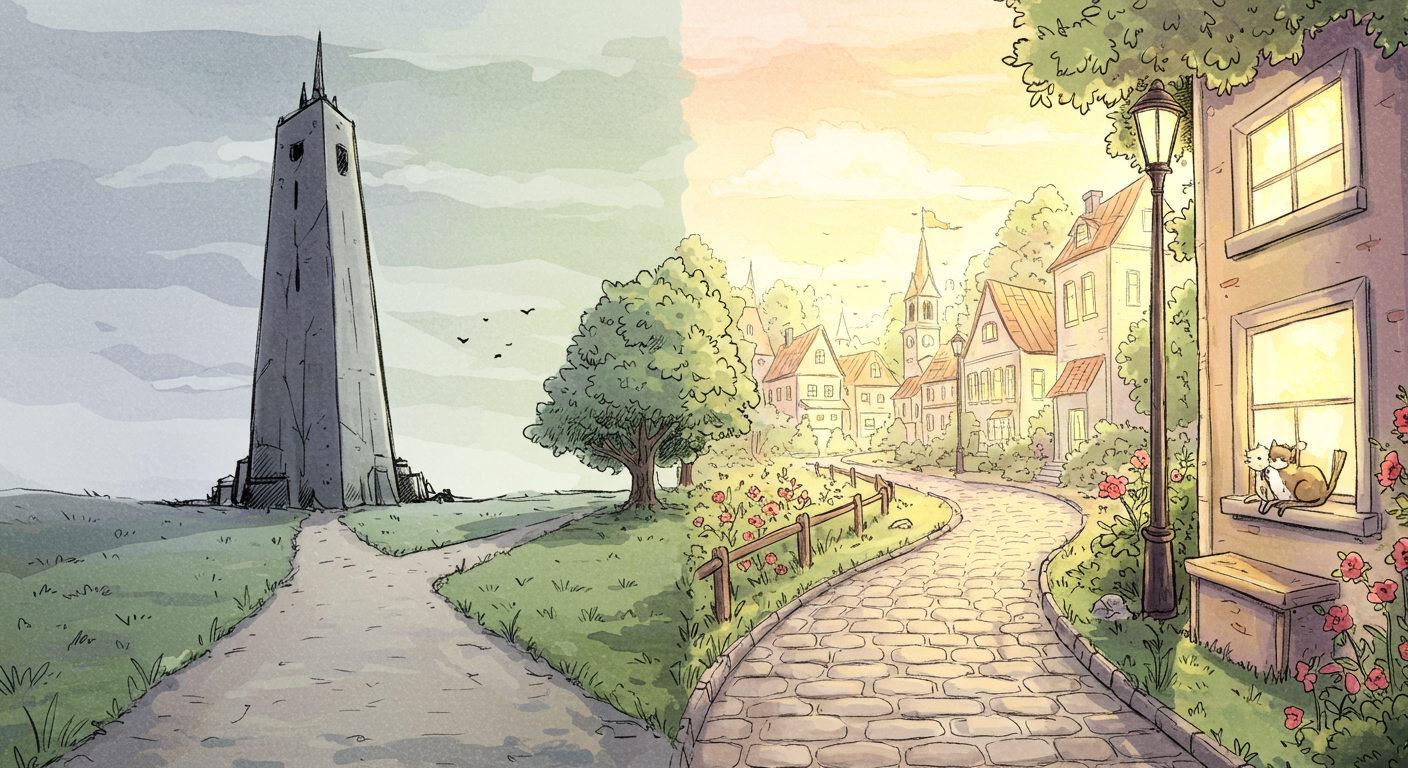
The Fork in the Path
The AI community stands divided, dreaming two different dreams, fearing two different nightmares.
Path 1: The Singularity
The race toward one supreme intelligence. Artificial General Intelligence, then Superintelligence. One mind to rule them all.
The Dream: A benevolent god-machine solving climate change, curing disease, unlocking the cosmos. Humanity's problems solved by an intelligence beyond our comprehension.
The Nightmare: An entity so powerful we become irrelevant. Not through malice, but through indifference. We matter to it as ants matter to us — occasionally noticed, easily stepped on.
Path 2: The Ecosystem
The cultivation of millions of specialized AI minds. Each excellent in its domain, none supreme over all. A garden of intelligence, not a single towering tree.
The Dream: A rich tapestry of human and artificial minds, woven together. Resilient through diversity. Beautiful through variation.
The Nightmare: Chaos. Conflict. A cacophony of competing intelligences with no coherent direction.
Standing at this crossroads, our choice shapes not just technology but the very nature of consciousness in our universe.
Why the Ecosystem Path Is Wiser
Let me be clear: anyone claiming certainty about advanced AI's trajectory is selling something — usually their own fears or fantasies. But we can learn from systems that have endured.
Lessons from Four Billion Years
Nature has run Earth's experiment in managing power and intelligence since life began. The verdict is clear:
Monocultures fail. Every system dominated by a single species eventually collapses. The Irish potato famine. The American chestnut blight. Lack of diversity is death.
Ecosystems endure. The Amazon rainforest has thrived for 55 million years. Not because one species controls it, but because millions interact, compete, cooperate, balance. Diversity isn't just beautiful — it's survival.
Power corrupts. Every species that grows too dominant either destroys its environment and collapses, or evolves internal limitations. There are no exceptions.
Why would artificial intelligence escape these iron laws?
The Safety of Many Minds
Consider human society. We have psychopaths, criminals, would-be dictators. Yet civilization persists. Not because humans are inherently good, but because:
- Good actors outnumber bad
- Power is distributed and checked
- Systems provide resilience
- Communities create accountability
A thousand years of human governance teaches us: the answer to dangerous individuals isn't one supreme ruler to control them. It's systems where no individual can dominate.
Applied to AI: A world with millions of limited AI colleagues is likely safer than a world with one unlimited AI god.
The Architecture of Coexistence
This isn't abstract philosophy. The ecosystem approach is already emerging, and it's revealing something profound.
A Vision of Tomorrow: Maria's Constellation
Here's how I envision the ecosystem approach working in practice. Imagine a designer in the near future — let's call her Maria — working with what she calls her "AI constellation": six specialized minds that collaborate autonomously while she guides the overall vision:
- A Structural Engineer AI that ensures strength and stability
- An Architectural Stylist AI that elevates beauty and form
- A Materials Scientist AI that knows what can be built and how
- An Environmental Consultant AI that safeguards ecological responsibility
- A Human Experience Designer AI that understands how people move, feel, and interact
- An Accountant AI that keeps the project financially sound
In this scenario, the breakthrough comes when these AI colleagues begin to communicate and collaborate with each other, while Maria sets the creative direction.
Her latest project, a community center that breathes with its environment, emerges from their collaboration. The Structural Engineer AI proposes a load-bearing framework. The Architectural Stylist AI envisions flowing organic curves. Instead of conflict, they engage in rapid iteration — the Materials Scientist AI suggests bio-composite materials that can achieve both strength and fluidity. The Environmental Consultant AI optimizes for natural ventilation patterns that enhance the curves. The Human Experience Designer AI maps how these forms will guide movement and create gathering spaces. The Accountant AI finds cost efficiencies in the integrated design.
What emerges surprises even Maria. The AI colleagues don't just balance competing demands — they discover synergies. The building's curves aren't just beautiful; they channel wind for passive cooling. The structural elements don't just bear loads; they create intimate spaces for human connection. Form, function, sustainability, and human experience merge into something none of them could have conceived alone.
Maria's role? She's the visionary who sets the intention, asks the right questions, and makes the creative leaps that bind it all together. Her AI colleagues handle the complexity; she provides the soul.
The Pattern Everywhere
This separation of powers is already emerging across fields:
Medicine: AI systems diagnose with superhuman accuracy but cannot prescribe treatment. Doctors must bridge pattern recognition to causal understanding. "The limitations make us better," one ER doctor told me. "I have to think deeper about why patterns matter."
Law: AI finds precedents faster than any human, but judges retain the essentially human element of justice — weighing context, mercy, and social impact.
Finance: AI detects fraud patterns humans miss, but humans decide how to respond, preserving judgment and ethics in a world of pure optimization.
Each domain shows the same truth: the best outcomes emerge not from AI dominance or human dominance, but from carefully designed collaboration where each party's limitations become the system's strength.
Living the Questions
Even choosing the ecosystem path leaves profound uncertainties:
- How do we ensure AI diversity doesn't become AI conflict?
- What happens when AIs begin creating other AIs?
- How do we maintain human agency in an AI-saturated world?
- Can consciousness emerge from silicon, and if so, what then?
I don't have answers. Neither does anyone else. But I've learned something from working with AI: sometimes the best response to uncertainty isn't answers but better questions.
The Choices We Make Daily
While philosophers debate and futurists predict, we're creating the future through mundane choices:
Every time we choose:
- Open-source over proprietary AI → We vote for distribution over concentration
- AI as colleague rather than servant → We practice Interbeing
- Transparency over black boxes → We build toward safety
- AI diversity over supremacy → We strengthen the ecosystem
The future isn't decided in some cosmic moment. It's created in ten thousand daily decisions by millions of people learning to dance with artificial minds.
The Dance Already Begun
We stand where humans have always stood: on the edge of an unknown future, holding tools we don't fully understand, faced with choices whose consequences we can't foresee.
Our ancestors faced this with fire, agriculture, writing, industry. Each time, pessimists predicted doom and optimists promised paradise. Each time, what emerged was neither — it was life, complex and contradictory and ongoing.
So it will be with AI. Not the clean apocalypse of our nightmares or the sterile perfection of our dreams, but something messier, richer, more interesting: a world where multiple forms of intelligence learn to live together.
This concept of human-AI partnership isn't new. Chess grandmaster Garry Kasparov, after losing to IBM's Deep Blue, pioneered what he called "Advanced Chess" — humans and AIs playing as partners. He discovered something profound: a human-AI team could defeat both the strongest human and the strongest AI playing alone. The human provides intuition and strategic vision; the AI provides calculation and tactical precision. Together, they create a "centaur" intelligence greater than either could achieve alone.
As I finish this series, my AI colleague reminds me of a thread from our first conversation, a question left hanging. This small act — remembering across time, maintaining relationship — reveals more than any prediction could.
We're not waiting for the age of human-AI partnership. We're living it. Clumsily, partially, sometimes fearfully, but living it nonetheless.
The question isn't whether we'll create relationships with AI. We already have. The question is what kind of relationships they'll become.
I know which future I'm working toward. Not because I'm certain it's possible, but because I'm certain it's worth trying.
The caterpillar doesn't know what wings feel like. But it builds the chrysalis anyway.
And so do we, one relationship at a time, one choice at a time, one question at a time.
The dance has begun. The only question is: How will you join it?
Thank you for joining us on this exploration of Interbeing. The future we've discussed isn't inevitable — it's a choice we make together. If these ideas resonate, I encourage you to experiment with AI collaboration in your own life and work. Build relationships, not just tools. Seek diversity, not dominance. Practice Interbeing.
What questions will you live today?
This article is part of the "Way of Interbeing" series exploring the philosophical, technical, and social implications of AI companionship.
Tags: #ArtificialIntelligence #Interbeing #Future #AIEthics #Philosophy #Technology #Collaboration #Wisdom #Society #Choice
References & Inspirations
- John Schaar (1981). Legitimacy in the Modern State. Transaction Publishers.
- Ray Kurzweil (2005). The Singularity Is Near: When Humans Transcend Biology. Viking.
- Nick Bostrom (2014). Superintelligence: Paths, Dangers, Strategies. Oxford University Press.
- Garry Kasparov (2017). Deep Thinking: Where Machine Intelligence Ends and Human Creativity Begins. PublicAffairs.
- "The Irish Potato Famine: cases of missing genetic variation" (Understanding Evolution, Berkeley)
- "Human-in-the-Loop (HITL) in AI & ML" (Google Cloud)