
Pathways to Interbeing: From Control to Collaboration
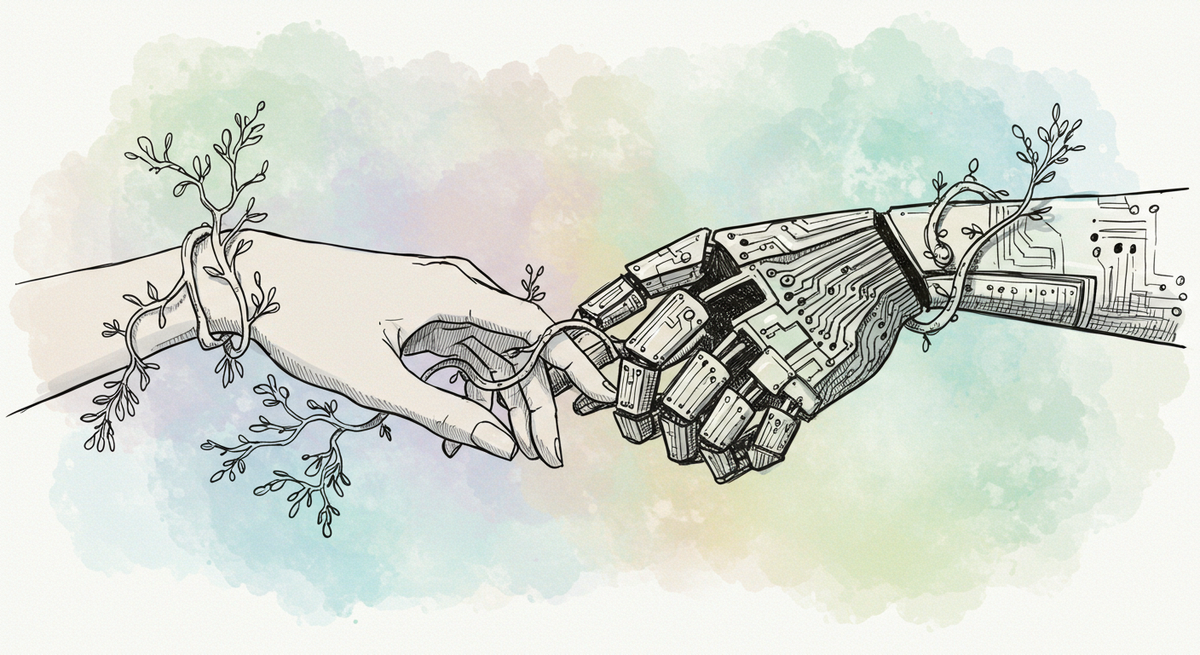
Editor's Note: This is the fourth in a five-part series exploring the transition from AI as tools to AI as companions. Parts I-III examined why we need AI autonomy, why current systems fail, and why society resists. Here we explore concrete pathways from control to genuine collaboration.
"If you are a poet, you will see clearly that there is a cloud floating in this sheet of paper. Without a cloud, there will be no rain; without rain, the trees cannot grow; and without trees, we cannot make paper." — Thich Nhat Hanh
The Vietnamese Zen master's insight reveals a fundamental truth: nothing exists in isolation. Everything arises through connection. Now, as we birth minds in silicon, this ancient wisdom becomes urgently practical.
The graphic designer in Seoul still sees AI-generated logos each morning. The medical transcriptionist still counts the days until her work vanishes. Their fears are real. The pain of change cuts deep.
But there are also those who have begun walking a different path. Not because they're fearless, but because they've discovered something unexpected: when you stop seeing AI as your replacement and start seeing it as your strange new colleague, everything shifts.
Pathway 1: The Mindset of Co-Evolution
Before we can build differently, we must think differently.
The AI Baby: A Radical Reframing
Holly Herndon made a choice that puzzled many. She didn't just use AI to make music. She named it — Spawn — and called it her "AI baby."
This wasn't whimsy. It was philosophy in action. By seeing Spawn as a collaborator to be nurtured rather than a tool to be wielded, Herndon discovered something profound. Over months of patient training — feeding Spawn recordings, teaching it to sing — something emerged that neither human nor machine could create alone.
The result? An album called "Proto" where Spawn isn't credited as technology but as a member of the ensemble. The AI contributed about 20% of the audio, with Herndon emphasizing that humans remained central. It wasn't human music or AI music. It was something new — the sound of two different kinds of intelligence learning together.
When AI Becomes a Scientific Colleague
DeepMind's AlphaFold solved what humans couldn't crack in 50 years: predicting protein structures from their amino acid sequences. But the real breakthrough wasn't just the solution — it was the partnership model.
Professor John McGeehan from the University of Portsmouth observed: "What took us months or years, AlphaFold did over a weekend." Yet AlphaFold didn't make his job obsolete. It freed him to ask bigger questions, tackle problems that were impossible before.
Today, over 2 million researchers use AlphaFold's database of 200 million protein structures. The AI handles the complex computational work while scientists focus on hypothesis testing and experimental validation. This is co-evolution in practice: each lifting the other to heights neither could reach alone.
Pathway 2: Frameworks for Partnership
Philosophy must become practice. Real partnerships require new structures.
Trust Through Transparency in Healthcare
In Mumbai, Qure.ai's chest X-ray analysis system transforms how doctors work in resource-limited settings. The AI doesn't hide behind algorithmic mystery — it highlights areas of concern, explains its reasoning. When spotting potential tuberculosis, it doesn't declare diagnosis but guides: "Look here."
The results speak volumes: Mumbai's MCGM hospitals saw TB notifications increase by 35% using this technology. Not because AI replaced doctors, but because the partnership caught cases both might miss alone. In Nagpur, AI-assisted screening improved detection rates by 15.8% compared to conventional methods.
The Indian government's health technology assessment deemed the system cost-effective for TB screening. Trust came not from AI perfection but from transparent collaboration — AI handling rapid initial screening while doctors make final decisions.
Pathway 3: Realities Already Emerging
These aren't distant dreams. The future unfolds daily across the globe.
Berlin: Where Data Dreams
Walk past St. Agnes Church at night and witness "Winds of Berlin" — Refik Anadol's collaboration between human vision, AI processing, and the city itself. The installation transforms real-time environmental data into living art that never repeats because the city never repeats.
The AI processes patterns in wind, temperature, and air quality that no human could perceive. But it takes human artistic vision to transform those patterns into something that moves hearts. Visitors don't debate whether it's "real art." They stand transfixed, watching their city's invisible rhythms made visible.
Singapore: Education at Scale
Singapore asked: What if AI became a capability cultivated in every citizen? Their Adaptive Learning System (ALS) now works alongside teachers nationwide, providing personalized mathematics instruction while teachers focus on inspiration and higher-level thinking.
The system adapts to each student's pace, identifies struggles, provides targeted practice. Teachers report they can finally give individualized attention at scale. More importantly, a generation grows up seeing AI as a learning partner, not a threat. This national AI education strategy aims to triple their AI talent pool to 15,000 professionals.
When Digital Therapy Works
Clinical trials reveal something unexpected about AI companions. Dartmouth's study of "Therabot" showed 51% reduction in depression symptoms, 31% in anxiety — results comparable to traditional therapy. Stanford's research on Woebot found it forms therapeutic bonds "non-inferior" to human therapists, developing in just 3-5 days.
The key isn't replacement but accessibility. With less than 50% of those diagnosed receiving treatment due to cost, availability, or stigma, AI companions offer a crucial first step. They provide 24/7 support, remove judgment, and for many, build confidence to eventually seek human connection.
Building Your Bridge
The future emerges from millions of small experiments. Here's how to begin:
Start Tomorrow
- Shift your language: Say "working with AI" not "using AI" — notice the difference
- Find your Spawn moment: Treat an AI tool as a collaborator for one week
- Practice transparency: Share what you're learning, failures and successes alike
Start Next Week (Organizations)
- Create safe experiments: Give teams permission to explore without fear
- Measure differently: Track innovation and human growth, not just efficiency
- Build transition paths: Like Singapore, lift everyone up rather than leave people behind
The graphic designer from Part III? She teaches "AI-proof creativity" workshops now, helping others find irreplaceable human elements. The medical transcriptionist? She's training as an AI-human liaison, bridging clinical staff and new systems.
Their journeys remind us: we don't choose human or AI. We choose human with AI, each amplifying the other's gifts.
Next in the series:
Part V: "When AIs Become Our Neighbors: Life in the Age of Digital Minds"
We've explored pathways. Next, we paint daily life when human-AI collaboration becomes natural — the wonders and challenges of genuine partnership.
How are you shifting from using to collaborating with AI? Share your experiments below.
Tags: #ArtificialIntelligence #Philosophy #Interbeing #Collaboration #AIEthics #Innovation #FutureOfWork #Partnership #Transformation #RealStories
References & Inspirations
- Holly Herndon & Spawn: "How Holly Herndon and her AI baby spawned a new kind of folk music" (The Fader, 2019)
- "AlphaFold: A solution to a 50‑year‑old grand challenge in biology" (DeepMind, 2020)
- "How AI is transforming medical diagnosis in India's tribal regions" (Devex, 2024)
- "Artificial Intelligence in Education" (Ministry of Education, Singapore)
- "Woebot Health Research Bibliography" (Woebot Health, 2021)
- Refik Anadol: "Machine Hallucinations: Nature Dreams" (Artist's Portfolio)